
New Educator Resources and Activity Time downloads: what's changed this term
05 Oct 2026
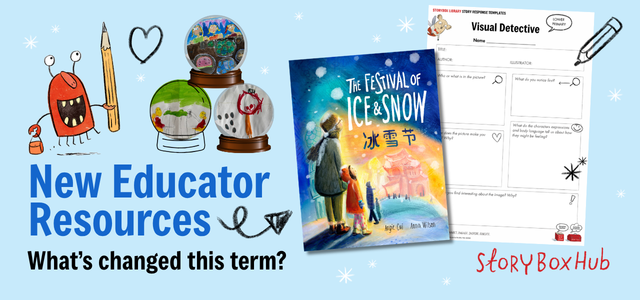
At StoryBox Hub, every story is chosen with care, read by a professional storyteller, and paired with educational resources mapped to relevant curriculum. Our multimodal story reads are the very definition of purposeful, quality screen time: guided, intentional learning where an educator sets the purpose from the very start, right through to classroom planning and teaching.
From Term Four, our Educator Resources and Activity Time downloads have been refreshed, and we're excited to share what's new.
Clear Alignment to Curriculum
The discussion prompts educators know and love are still there, and they remain aligned to curriculum. These discussion prompts continue to be crafted to help your students to delve deeper into the story, building comprehension skills as they explore character, setting and language. They also help to spark curiosity and engagement, encouraging students to ask questions and think more deeply about what they’ve read, while helping them to make personal connections between the story and their own experiences and ideas. What's changed is clarity. Where relevant, story read themes now call out curriculum keywords directly, so at a glance you can see exactly where a story fits your planning. For example, our first story for Term Four, The Festival of Ice and Snow lists significant events, symbols and emblems under themes. Year Three HASS (Version 9 Australian Curriculum) content descriptor AC9HS3K02, focusses on significant events, symbols and emblems that are important to Australia's identity and diversity.
Vocabulary
Each resource now includes a specific vocabulary list, set out in a pull-out box so it's visible at a glance. Vocabulary words include some everyday words and some high-value words such as descriptive and subject-specific vocabulary that build comprehension and academic language. It's a small design change, but one that saves educators time when planning a vocabulary-focused lesson or pre-teaching key terms. A great tip is to investigate vocabulary words before the story read and ask students to thumbs up when they hear a vocabulary word, or on subsequent readings with captions to spot the vocabulary words in the captions.
Multimodality
StoryBox Hub story reads are multimodal resources to complement use of print texts and offer a varied way to access story. Multimodality is defined by ACARA as a combination of two or more communication modes. Our Educator Resources now specifically call out the multimodal techniques our production team embeds in every story read, because the multimodality of a story read shapes how students experience the book differently from the print version of the book.
Our resources include key questions and discussion points across the linguistic, aural, visual, and gestural and spatial modes. Take The Festival of Ice and Snow (written by Angie Cui, illustrated by Anna Wilson, narrated by Susanna Qian, and published by University of Queensland Press) as an example.
For the linguistic mode, we ask students what they notice about the letters and symbols on the page in the story read's introduction. For the aural mode, we point to the sound effects the producer uses in filming, like Grandpa's laugh or the piano keys. For the visual mode, we draw attention to the twinkling lights in the background, which mirror the shape and colour of the lights in the book's illustrations, and we pause on the image of tanghulu being eaten to notice the burst of yellow and its matching sound effect. For the gestural and spatial mode, we ask students how the little girl and her grandpa feel about each other, and what tells them that. This story read was filmed at the Winter Glow Festival, with a toboggan slide at the end just like the one in the story, so we ask students to imagine what it might feel like to fly down a slide like that, and how their body would move.
This is the kind of detail that turns a story read from a ‘lovely to watch’ into a genuine teaching tool.
More ways to respond, and to save time
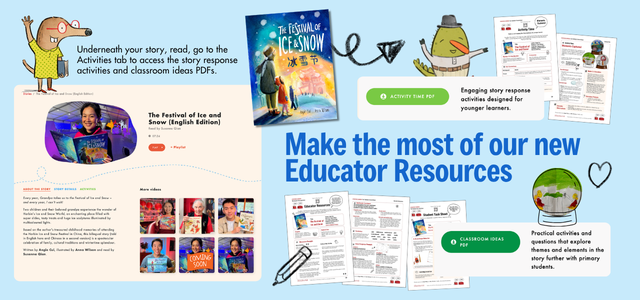
Every resource links to our ever-growing bank of Story Response Templates, created to support students in analysing and responding to texts in creative ways. You'll find templates for planning recounts and narratives, adverb search-and-sorts, cinquain templates and many more. These can be projected for whole-class use, printed for individual use, or used as a model in small groups, whether on paper, digital devices or mini whiteboards.
Our Student Task Sheets are designed for independent or partner literacy response activities, making them a great fit for independent literacy rotations.
Activity Time
Our Activity Time resources have also been refreshed, and now include a provocation, are mapped to the Early Years Learning Framework 2.0, connecting story reads to early childhood outcomes through play-based, inquiry-led learning.
Available with your subscription
All school subscriptions include educator resources and Activity Time downloads (found via the 'Activities' tab on each story page or in our dedicated Resources section), making StoryBox Hub a valuable addition to your school's annual digital subscriptions. Early learning centre subscribers have access to all our Activity Time resources. Every resource is built to enrich learning: hundreds of licensed, predominantly Australian books, read by professional storytellers, paired with curriculum-aligned resources and creative writing tutorials, all on one platform, ready whenever your staff need to embed a story into the curriculum.
Log in to StoryBox Hub to explore the refreshed resources on your favourite stories, or dive into something new.